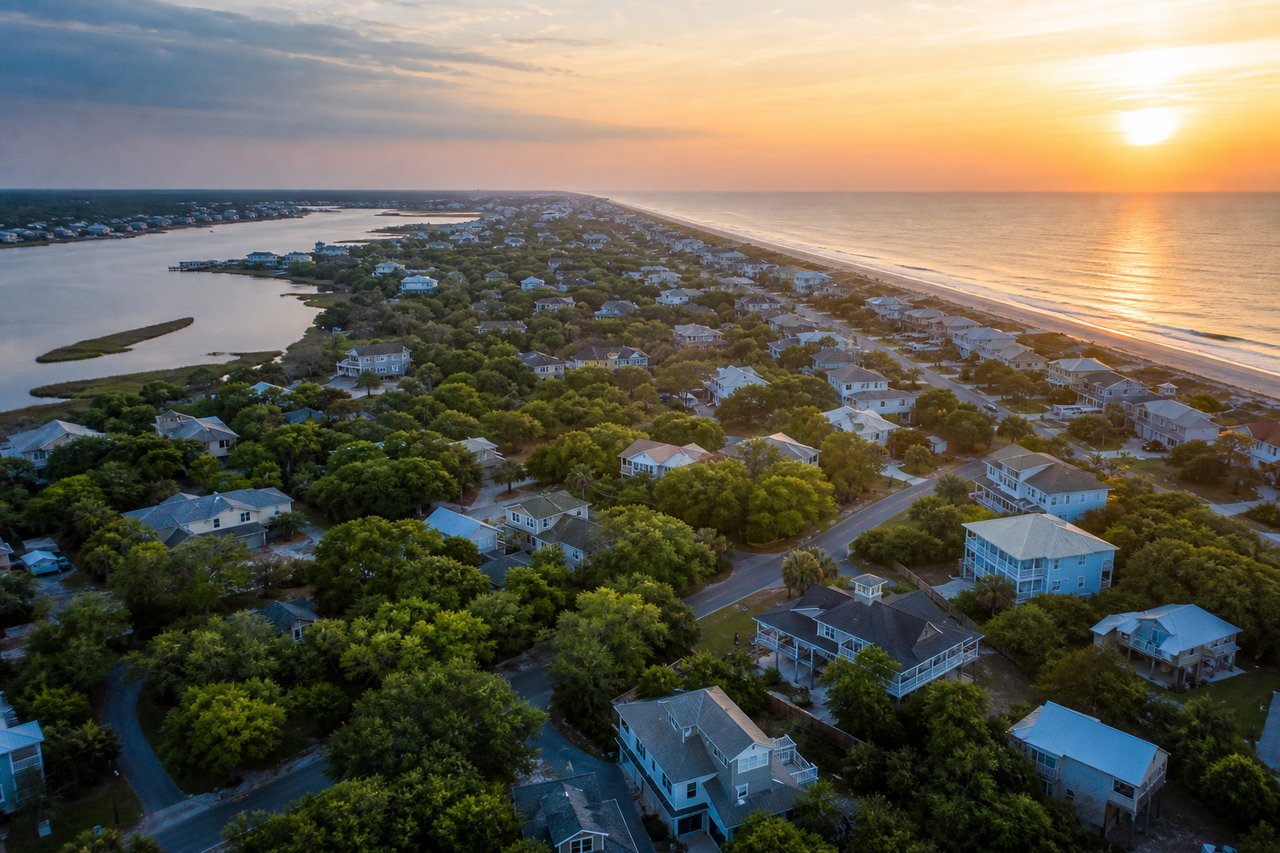
Price Above or Below Market on Crystal Coast?
Should you price your Crystal Coast home above or below market value?
In today's Crystal Coast market, most sellers are better served by market-accurate or slightly below-market pricing than by aspirational overpricing. The most recent data, from a 2025 Carteret County snapshot, shows an average of 102 days on market and a median home price of $558,500 countywide, with sold-to-list ratios running between 93% and 97% depending on the segment. Buyers have more inventory to choose from and more time to negotiate, so an inflated list price is more likely to lead to price reductions than competing offers.
Key Takeaways
- The most recent Carteret County data, from a 2025 snapshot reported by Realtor.com, shows an average of 102 days on market, up about 8.5% year over year, meaning buyers are taking their time and using that patience as negotiating leverage.
- Emerald Isle's sales-to-list ratio sits around 97% according to Realtor.com's Emerald Isle market page, while some Crystal Coast luxury segments are closing closer to 93% of asking price, so buyers are routinely negotiating 3–7% off list.
- The Federal Reserve's house price index for Carteret County rose from 297.43 in 2024 to 325.76 in 2025, confirming the market is still appreciating, but appreciation alone doesn't protect an overpriced listing from sitting.
- Submarket matters: Pine Knoll Shores averaged around $841,250 per sale in August 2025, while Swansboro averaged around $454,205, so the right pricing strategy in one town can be the wrong one in another.
- Vacation-rental and second-home buyers underwrite purchases based on cash flow; if your list price doesn't pencil out as a rental investment, they'll skip your listing rather than negotiate it down.
What does the Crystal Coast market actually look like heading into late 2026?
Here's what I tell every seller who asks me this question: the answer depends on your specific submarket, your property type, and what the data says about buyer behavior in your price band right now.
The most recent countywide figures paint a clear picture. A 2025 snapshot from Realtor.com's Carteret County market summary shows a median home price of $558,500, a median price per square foot of $335, 1,077 active listings, and an average of 102 days on market. That days-on-market figure is up about 8.5% year over year. Meanwhile, Rocket Homes' May 2025 Carteret County report put the median sold price at $513,900, up 5.8% from May 2024, with 788 homes for sale, up 4.4% from the prior month.
Prices are still rising. Inventory is also rising. Days on market are stretching. That combination tells me buyers have more choices and less urgency than they did in 2021 or 2022, and that changes everything about how you should price.
The Federal Reserve's All-Transactions House Price Index for Carteret County confirms the appreciation story: the index moved from 297.43 in 2024 to 325.76 in 2025. Values are going up. But a rising market doesn't automatically reward overpricing; it rewards correct pricing, because buyers in an appreciating market with growing inventory know they have options.
The North Carolina REALTORS® December 2025 Housing Report reinforces this statewide: North Carolina's market was cooling from its pandemic peak by late 2025, and buyer sensitivity to price was rising across the board.
Submarket | Average Sale Price (Aug 2025) | Active Listings (Aug 2025) | Homes Sold (Aug 2025) |
|---|---|---|---|
Pine Knoll Shores | $841,250 | 26 | 12 |
Cape Carteret | $545,333 | 14 | 6 |
Swansboro | $454,205 | 66 | 21 |
Emerald Isle (median listing) | $798,500 | ~142 | 81–85 days avg. on market |
Carteret County (countywide median sold) | $513,900 (May 2025) | 788 | 102 days avg. on market |
Sources: August 2025 Crystal Coast submarket data; Rocket Homes May 2025; Realtor.com Emerald Isle 2025 snapshot. Submarket figures are from a local market report and reflect averages, not official MLS data.
How do the three pricing strategies actually play out on the Crystal Coast?
Pricing above market: when it works, when it backfires
Aggressive above-market pricing is not automatically a mistake, but the window where it works is narrower than most sellers want to believe.
In my experience, it has the best chance in submarkets with genuinely limited inventory in a specific niche: a renovated oceanfront property in Pine Knoll Shores, an ocean-view home in Atlantic Beach with strong short-term rental income history, or a turnkey waterfront listing in a price band where comparable sales are sparse. Pine Knoll Shores averaged around $841,250 per sale in August 2025 with only 26 active listings and 12 sales that month, a tight enough supply that a uniquely desirable property can command a premium.
Above-market pricing backfires in Emerald Isle and similar high-price, slower-moving coastal segments. Bankrate's January 2025 Emerald Isle data showed homes selling after an average of 88 days on market, compared with just 16 days in January 2024. That shift in pace is enormous. Prop-Metrics' analysis of Emerald Isle ZIP 28594 put the median days on market around 94 as of October 2025, a roughly 24% year-over-year increase.
When buyers have 90-plus days to shop, they are not in a hurry to pay above asking. They watch for price reductions, and a listing that sits creates a perception problem: buyers start wondering what's wrong with it. A price cut after 60 or 90 days often nets you less than a sharp list price would have on day one.
Local 2026 YTD commentary from Crystal Coast market observers notes a sold-to-list ratio around 93% in some segments and an absorption rate near 8.1 months. That means buyers are already closing several percentage points below asking on average. If you list 8% above market, you're not starting a negotiation at your target price; you're starting a long wait that may end with a price cut that overshoots what you would have accepted anyway.
Market-accurate pricing: the most reliable path in most segments
Market-accurate pricing means anchoring your list price to what comparable homes have actually sold for recently, in your specific submarket and price band, not what you hope the market will pay.
In Emerald Isle, that anchor sits in the $798,500–$854,000 range based on the most recent available data from Realtor.com's Emerald Isle market page and local synthesis data. The sales-to-list ratio there runs around 97%, meaning buyers negotiate a few percent off but don't dramatically lowball. A home priced accurately at market tends to attract serious buyers quickly, which keeps you from accumulating the days-on-market stigma that triggers deeper discounts later.
For Swansboro and Cape Carteret, where average sale prices in August 2025 ran around $454,205 and $545,333 respectively, market-accurate pricing is especially important because buyers in those price bands are often more payment-sensitive. A $20,000 overprice in Swansboro is a bigger relative deal-breaker than the same dollar amount in Pine Knoll Shores.
If your goal is a fast, clean sale, market-accurate pricing is almost always the right starting point. My post on selling your home fast on the Crystal Coast goes deeper on the tactics that complement a sharp list price.
Strategic underpricing: when it creates urgency instead of leaving money on the table
Pricing slightly below market is a deliberate strategy, not a sign of desperation. Done right, it compresses the timeline and can generate competing interest in a market where buyers have otherwise been patient.
It works best in segments with an identifiable buyer pool and rising inventory, where buyers have been conditioned to wait for price reductions. If you price just under the dominant price band in Swansboro or Cape Carteret, say, just under $450,000 when most comparable listings are sitting at $460,000–$475,000, you become the obvious value play for every buyer actively watching that segment.
It can also work in Emerald Isle for properties that photograph exceptionally well and have strong rental income documentation. Vacation-rental buyers and second-home investors are running cash-flow numbers before they call their agent. If your list price puts the monthly math in their favor, they act quickly. If it doesn't, they move on; they don't negotiate you down; they just skip your listing entirely. My Crystal Coast rental market investment guide covers how STR buyers underwrite these purchases, which directly affects what price point triggers their interest.
The risk with underpricing is real: if your market analysis is off and you're actually below true market value, you may not get the competing offers you hoped for, and you've simply priced too low. This strategy requires a precise read on current demand, not a guess. That's where a thorough comparative market analysis from someone who knows this specific market makes all the difference.
How do you know which strategy fits your home?
The honest answer is that it depends on four things: your submarket, your property's condition and uniqueness, current active competition, and your timeline.
A renovated oceanfront property in Pine Knoll Shores with a documented rental history and no direct competition in its price band can support above-market pricing. A three-bedroom canal home in Emerald Isle with deferred maintenance and four similar listings nearby cannot. Those are not the same conversation, and applying the same pricing logic to both is how sellers end up chasing the market down with successive price cuts.
Here's what I walk every seller through before we set a number: What have comparable homes actually sold for in the last 90 days? How many competing listings are active right now? What is the current days-on-market trend for this price band? And what is the buyer profile most likely to purchase this home, primary resident, second-home buyer, or STR investor, because each group has a different price sensitivity threshold.
Your specific number depends on all of those factors together. That's exactly the kind of analysis I run before we ever put a sign in the yard.
Frequently Asked Questions
Is it smarter to price my Crystal Coast home a little below market to spark a bidding war, or list at full market value?
In most Crystal Coast submarkets right now, listing at accurate market value is the safer starting point, with strategic underpricing reserved for properties with strong rental appeal or those competing in a crowded inventory segment. The most recent data shows Carteret County averaging 102 days on market and sold-to-list ratios between 93% and 97%, which means a bidding war is possible but not guaranteed, and it requires genuinely sharp pricing plus a property that stands out. If your home is turnkey, well-documented for rental income, and priced just under the dominant comparable sales, you have a real shot at compressed timelines and competing interest.
How long are homes really sitting on the market in Emerald Isle right now?
Based on the most recent available data, Emerald Isle homes have been averaging 81–94 days on the market, depending on the source and time window. Realtor.com's Emerald Isle snapshot puts the median at 81 days, while Prop-Metrics' October 2025 analysis of ZIP 28594 shows a median closer to 94 days, up about 24% year over year. Either way, that's well above the national pace of around 55 days, which means buyers in Emerald Isle are taking their time and using that patience as leverage in negotiations.
What does pricing above market actually mean in Carteret County if buyers are negotiating 3–7% off list anyway?
It means you're not really pricing above market; you're pricing above your target net, hoping buyers will negotiate down to where you actually want to land. The problem is that buyers in a market with 100-plus days on market don't always negotiate; they often just wait for a price reduction instead. Redfin's October 2025 Carteret County data showed prices still up about 9.2% year-over-year, so the market isn't falling, but a listing that sits 60 or 90 days accumulates a perception problem that can cost you more in the final negotiation than a sharp original price would have.
If the average days on market is 80–100 days in Emerald Isle, what happens if I overprice my beach house?
You risk becoming a stale listing in a market where buyers have plenty of alternatives and no urgency to act. Once a listing crosses 60–90 days without an offer, buyers and their agents start asking what's wrong with it, and the price reduction you eventually make is often deeper than the premium you were trying to capture in the first place. In Emerald Isle specifically, where the sales-to-list ratio already runs around 97% under normal conditions, starting above market adds a second negotiation gap on top of the one buyers already expect.
Do vacation-rental and second-home buyers on the Crystal Coast care more about price or about getting a turnkey property?
Both matter, but they interact in a specific way: STR buyers and second-home investors are running cash-flow math before they schedule a showing. A turnkey property priced to pencil out as a rental investment will move quickly; a turnkey property priced above the level where the numbers work will get skipped, not negotiated down. Price is the first filter, condition is the second. If your list price puts the monthly math out of reach for a rental investor, no amount of staging or photography will bring them back to the table, and on the Crystal Coast, where a large share of buyers are purchasing for rental income potential, that's a significant portion of your buyer pool to lose.
If you're not sure where your home fits in this picture, that's exactly the conversation to have before you list. Send me an email, and I'll put together a comparative market analysis specific to your home, your submarket, and the buyer profile most likely to purchase it. Or browse current listings at buyingnc.com to see what's active in your price band right now.
Equal Housing Opportunity. Vicki Lemmond, NC License #226908, REAL Broker LLC, regulated by the NC Real Estate Commission. This article is general market information only and does not constitute legal, tax, or financial advice. Confirm your own pricing strategy, costs, and transaction details with your closing agent, tax advisor, or lender.