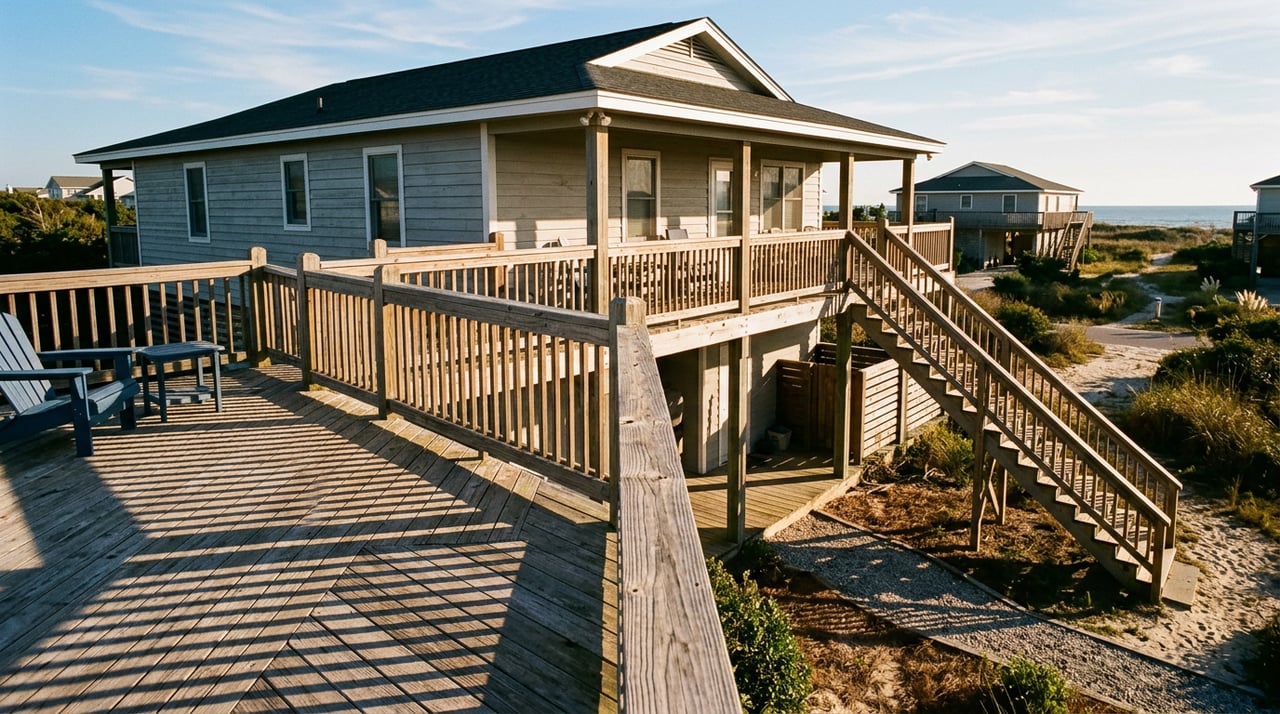
A buyer comparing listings in Carteret County will notice something odd within the first afternoon of scrolling. A three-bedroom cottage in Emerald Isle carries a price tag that would buy something twice its size a few miles down the road in Davis. The county's own median sale price sits in between both numbers, which makes it look like a tidy middle ground. It isn't. It's a blend of several small markets that behave nothing alike, and the gap between them has less to do with sand and more to do with what each town actually lets an owner do with the property once the closing is done.
That distinction matters more than most buyers realize until they're already under contract.
The number nobody should underwrite against
Over the three months ending May 2026, homes in Carteret County sold for a median price of $508,000, up 13.6% from the same stretch a year earlier. Homes also sat longer before closing: a median 63 days on market, more than double the 28 days recorded the year before, and the volume of closed sales dipped too, with 140 homes selling in May 2026 compared to 163 in May 2025. Separately, average home values across the county stood at $478,286 as of June 2026, up 2.6% year over year, with homes going to pending status in around 37 days.
Put those together and you get a market that's still gaining value but taking longer to close, with fewer transactions clearing each month. That's a fair description of the county as a whole. It's a poor description of any one house in it.
The county's own price-per-square-foot data, tracked publicly by the Federal Reserve Bank of St. Louis, put the median listing price at $353 per square foot as of June 2026. That figure is useful for spotting a trend line. It's not useful for pricing a specific parcel on Bogue Banks, because it averages together oceanfront condos, sound-side cottages, working-waterfront homes in Morehead City, and inland lots near Newport that have never seen a tourist. A single county number can't carry that weight, and treating it like it can is how buyers overpay in one town and underbid in another without realizing it.
The current spread between the county's most and least expensive markets makes the point plainly. Emerald Isle carries the highest median listing price in the county, sitting near $899,900, while Davis, on the county's Down East side, averages closer to $263,000. That's not a rounding difference. That's two different products being sold under one county name.
Same coastline, different rulebook
Here's the part that doesn't show up on a listing sheet: the reason those prices diverge isn't just distance to the ocean. It's what each town's own rules let an owner do with the house.
Walk the county town by town and the ground shifts under your feet. Emerald Isle has built its market around vacation rental as an expected use in most residential zones, which is part of why it commands the county's highest prices. Move a short drive down Bogue Banks to Pine Knoll Shores and the character changes. It's a quieter, more residential town with several private communities, and the town itself has historically leaned on informing renters about local noise and parking rules rather than building a formal rental permitting system, which means a lot of the real control sits inside each community's own recorded documents, not town hall.
Cross the bridge into Morehead City and the picture gets more layered still. The town holds a historic walking district full of early-1900s cottages a few blocks from the water, a working state port, and inland residential streets that never touch tourism income at all. A property in the historic district and a property a mile inland can carry entirely different rental expectations even though both sit inside the same town limits.
Head further into the county and you leave incorporated towns altogether. Harkers Island and most of the Down East communities are unincorporated, which means county rules govern the property directly, not a town council. That single fact changes who a buyer needs to call to confirm what's allowed, and it's the kind of detail that only shows up when someone is actually working a transaction, not reading a brochure.
None of this means one town is better than another. It means the rules a buyer is purchasing into vary as much as the price does, and the two are connected. A house with more use flexibility tends to command more of a premium than one without it, all else equal.
What that means before you write an offer
A seller or a listing description saying "short-term rentals allowed" is not proof of anything on its own. It might reflect the seller's own past use, a neighbor's experience, or a general impression of the town rather than a confirmed answer for that specific parcel. Before treating rental income as part of the math on an offer, it's worth confirming a few things directly:
- Whether the town itself regulates rental use, or whether that authority sits with an unincorporated county rule, a homeowners association, or both.
- Which zoning district the specific parcel sits in, since two houses a block apart can fall into different districts with different allowances.
- Whether the property is subject to a private covenant or association document that restricts use regardless of what the town or county allows.
- Whether occupancy limits tie to septic capacity or building code, which can cap how many guests a legally rentable property can actually sleep.
None of that shows up in a median price. All of it shows up in a closing.
The legislative wildcard sitting in Raleigh
There's one more piece worth watching if a purchase decision leans on future rental income. North Carolina has no single statewide short-term rental license. Instead, compliance runs through whichever city or county the property sits in, which is exactly why the rules vary as much as they do across Carteret County's own towns.
A bill filed in the state legislature in March 2025, Senate Bill 291, would change that balance somewhat. As introduced, it would bar cities and counties from banning residential short-term rentals outright, cap permit fees at $25, and set a statewide floor on occupancy limits. As of early 2026, the bill hadn't advanced since its introduction, so nothing has changed yet on the ground. But it's a reminder that the rules governing what a buyer can do with a coastal property aren't fixed forever. Anyone weighing a purchase partly on projected rental income should treat today's local rule as today's answer, not a permanent one.
What the spread is actually telling you
The lesson from Carteret County's price map isn't that the beach towns are expensive and the inland ones are cheap. It's that the price of a house here reflects, in part, a bundle of rights that comes attached to it: what you can rent it as, to whom, for how long, and under whose authority. Emerald Isle's premium and Davis's affordability both make sense once you see them as prices for different bundles, not different views.
For a buyer comparing towns rather than just comparing photos, that's the number worth chasing down before the county median, not after.
If you're weighing a purchase across Carteret County's towns and want to understand what a specific property's use rules actually allow before you write an offer, Buying NC can help you compare towns with the right questions already asked. See if you qualify for NC Home Advantage as part of that conversation.
A few questions worth asking early
Does a strong rental history transfer with the house? Not automatically. A property's past income says nothing about whether the current zoning, permit status, or association rules still allow the same use going forward. Confirm current status rather than relying on past performance.
Are Down East communities regulated the same way as the beach towns? No. Harkers Island and most Down East communities are unincorporated, so county rules apply directly rather than a town ordinance, which changes who you'd contact to confirm what's allowed on a given parcel.
Will Senate Bill 291 change any of this soon? Possibly, but not yet. As of early 2026 the bill hadn't moved since its March 2025 introduction. Treat current local rules as the operative answer until something actually passes.