Can you really maximize ROI on a waterfront home in Indian Beach, NC?
Yes, Indian Beach waterfront properties offer genuine investment upside, but only when you underwrite them correctly. The town's extremely limited inventory, barrier-island location on Bogue Banks, and strong Crystal Coast vacation demand create favorable conditions for appreciation and rental income. The key is knowing exactly what you're buying: oceanfront, soundfront, canal-access, or second-row with deeded access each carries a different risk and return profile.
Why Indian Beach Is Worth a Serious Look
Indian Beach sits between Atlantic Beach and Emerald Isle on Bogue Banks, and it is genuinely small. According to the U.S. Census Bureau, the town's 2020 Census population was just 112 people. That kind of scarcity is actually an investor's friend: limited housing stock means limited competition for buyers and renters, and true oceanfront lots don't get created.
The same Census data shows a median household income of $99,167 for Indian Beach (2019-2023 American Community Survey), which reflects the purchasing power of the ownership base. And with an owner-occupancy rate of 91.1%, this isn't a town flooded with distressed rentals or absentee-landlord inventory. The properties here tend to be well-maintained, and the resale pool skews toward serious buyers.
For county-level context, the Carteret County median home value was $353,700 in the same 2019-2023 ACS period. True waterfront in Indian Beach trades well above that baseline, which is worth keeping in mind as you model your entry price and exit assumptions. These figures are the most recent available as of August 2026, so treat them as a directional anchor rather than a live market reading.
When I work with investors on Bogue Banks, I always start by asking one question: what type of waterfront are you actually buying? The answer shapes everything else.
Oceanfront vs. Soundfront vs. Canal Access
These categories are not interchangeable from an ROI standpoint:
- Oceanfront commands the highest rental premiums and the strongest resale demand. It also carries the highest insurance exposure and the most direct erosion risk.
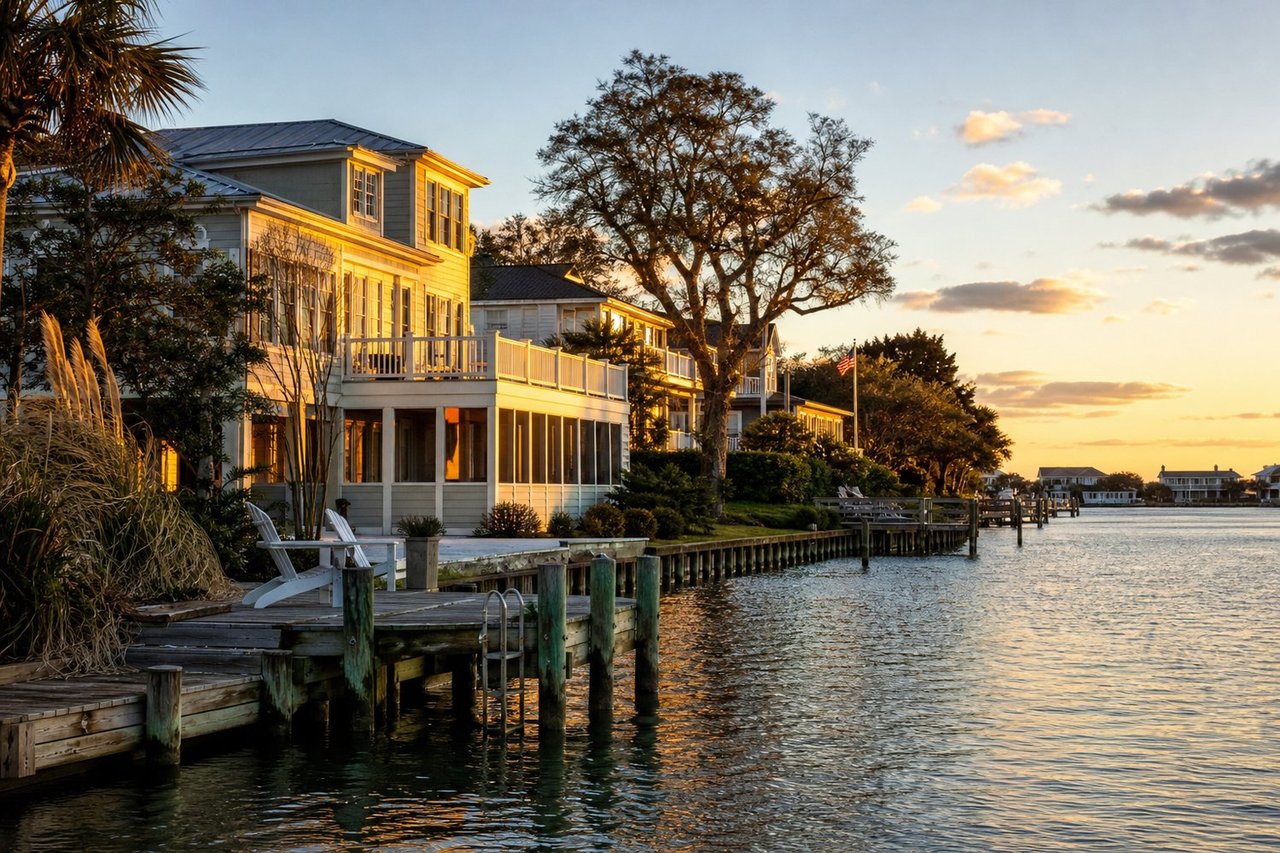
- Soundfront (Bogue Sound/Intracoastal Waterway side) typically offers calmer water, sunset views, and boating access. Rental rates run lower than oceanfront, but so do insurance costs in many cases. Strong appeal for fishing and boating buyers.
- Canal-access homes offer direct boat launch without the oceanfront price tag. The trade-off is that rental demand is usually softer than true waterfront, and resale depth is narrower.
- Second-row with deeded beach access can offer a lower acquisition cost with meaningful rental appeal, but verify the access easement carefully. Deeded access terms vary significantly.
I walk every investor client through this distinction before we even start running rental income projections. The wrong waterfront type for your goals can quietly kill your returns.
The Underwriting Steps That Determine Your Real Return
ROI on a waterfront home isn't just a rental-income calculation. It's the income minus the carrying costs you may not have fully priced in. Here's where I see investors leave money on the table, or worse, get surprised after closing.
Step 1: Flood Zone Verification Before You Make an Offer
This is non-negotiable for any Bogue Banks property. FEMA flood maps are the primary federal reference for flood-risk classification, and your flood zone determines whether flood insurance is required by your lender and what it costs. On a barrier island like Indian Beach, flood zone designation can vary dramatically from one street to the next.
Don't treat this as a post-contract discovery. Run the flood check before you finalize your offer, because it directly affects your financing terms and your annual carrying costs. I've seen investors underestimate flood insurance by a wide margin and watch their projected cash flow evaporate.
Step 2: Get a Real Insurance Quote Early
Coastal North Carolina insurance has gotten more complex. Wind and hail coverage, flood coverage, and standard homeowner's coverage may come from three separate carriers on a waterfront property. Get actual quotes, not estimates, before you commit. The difference between a favorable zone and an adverse one can mean thousands of dollars per year in carrying costs that never show up in a listing's pro forma.
Step 3: Screen Local Rental Rules by Property, Not by Town
Indian Beach allows short-term rentals at the town level, but individual subdivisions and HOAs may impose stricter rules than the town's baseline. Before you build a short-term rental income model, verify the specific property's HOA documents, any deed restrictions, and current town ordinances. This is a property-specific compliance step, not a single market-wide answer, and it changes. I always pull the HOA docs and town code for my investor clients before we go under contract.
Step 4: Understand Your Transaction Costs
North Carolina's deed excise tax is set by statute at $1 per $500 of the sales price (with a $2 minimum), per the North Carolina Department of Revenue. That's a fixed, predictable line item. Other closing costs, including title insurance, attorney fees, and the due diligence fee, are transaction-specific or negotiated between the parties. The North Carolina Real Estate Commission notes that the due diligence fee is negotiable and not a statutory amount. For a personalized closing-cost picture, I'll put together a consultation and walk through your specific scenario.
Step 5: Review the Seller's Disclosure Carefully
North Carolina requires a property disclosure statement in most residential sales, per the NC Real Estate Commission. For waterfront homes, this review is especially important. Coastal properties can surface issues involving flooding history, erosion, septic systems, and water access that a standard disclosure review might miss if you're not looking for them. I read every disclosure with a coastal lens, not a suburban one.
Waterfront Type | Typical Rental Appeal | Key Risk Factors | Resale Depth |
|---|---|---|---|
Oceanfront | Highest peak-season demand | Erosion, high insurance, flood zone | Strongest, broadest buyer pool |
Soundfront | Strong, boating/fishing focus | Moderate insurance, access verification | Good, narrower buyer profile |
Canal Access | Moderate, boat-launch appeal | Water quality, HOA rules, easements | Narrower, price-sensitive |
Second-Row w/ Deeded Access | Good value-to-rent ratio | Easement terms, access reliability | Moderate, access quality matters |
Short-Term vs. Long-Term Rental: Which Strategy Wins?
Crystal Coast vacation demand is heavily seasonal. The strongest performance window runs from late spring through summer, roughly May through September, when beach-rental demand peaks. That seasonal concentration is a feature for short-term rental investors who can optimize pricing during peak weeks, but it also means your annual income is front-loaded and you need to plan for shoulder-season carrying costs.
Short-term rentals in Indian Beach can generate meaningful weekly revenue during peak season, but they require active management, higher maintenance budgets, and compliance with the property-level rules I mentioned above. If you're not local or don't have a reliable property manager, factor that cost in before you build your projections.
Long-term rentals offer steadier cash flow and lower management intensity, but the income ceiling is lower than a well-run short-term operation during peak months. Some investors I work with run a hybrid: short-term during peak season, mid-term (monthly) during the shoulder, and reassess annually.
The right answer depends on your goals, your risk tolerance, and the specific property. That's not a hedge; it's just true. Every situation is different, and the only way to know which model fits is to run the numbers with someone who knows this market. I do that analysis for my investor clients before we make an offer, not after.
For a deeper look at buying investment property in Carteret County more broadly, my post on buying a second home or rental in Carteret County walks through the ownership structure and financing considerations that apply here too. And if you're evaluating a specific offer, the guidance in making a strong offer on a Carteret County coastal home covers the contract terms that matter most in a competitive coastal deal.
Frequently Asked Questions
How much do Indian Beach waterfront homes usually rent for in peak summer season?
Peak-season rental rates in Indian Beach vary significantly by waterfront type, bedroom count, amenities, and proximity to the water. Oceanfront homes with direct beach access command the highest weekly rates, while soundfront and canal-access properties typically rent for less. Because Indian Beach has very limited inventory, property-level comparables matter far more than town-wide averages. I pull actual rental comps for my investor clients before they make an offer.
What flood zone is my Indian Beach property in, and how do I check it?
You can look up any property's flood zone designation using the FEMA Flood Map Service Center by entering the property address. On a barrier island like Indian Beach, flood zone designations can vary street by street, so always check the specific parcel rather than relying on a neighborhood generalization. Your lender will also order a flood certification at closing, but I recommend checking this before you make an offer, because it affects both your financing options and your insurance costs.
Are Indian Beach waterfront homes better as short-term rentals or long-term rentals?
Short-term vacation rentals typically generate higher gross income during peak season (roughly May through September on the Crystal Coast), while long-term rentals offer more predictable year-round cash flow with lower management demands. The best strategy depends on your property type, your management capacity, and the specific HOA and town rules that apply to your parcel. Some investors run a hybrid model, and that's worth modeling before you commit to either approach.
How does beach access or sound access affect pricing in Indian Beach?
Direct oceanfront access commands the highest premiums in Indian Beach, both for resale value and rental income. Soundfront properties appeal to boating and fishing buyers and typically carry lower insurance costs than oceanfront, though they trade at a discount to ocean-side homes. Second-row properties with deeded beach access can offer a lower entry price with meaningful rental appeal, but the quality and reliability of the access easement is a critical underwriting detail that needs to be verified in the title work.
What closing costs should investors expect on a waterfront purchase in North Carolina?
North Carolina's deed excise tax is fixed by statute at $1 per $500 of the sales price, per the NC Department of Revenue. Other costs, including title insurance, attorney fees, lender fees, and the due diligence fee, are either transaction-specific or negotiated between the parties. For a waterfront property, flood insurance and wind coverage quotes should be factored into your carrying-cost model before you close. I walk my investor clients through a full cost picture in consultation, not on a generic worksheet.
What insurance challenges come with buying a waterfront home on Bogue Banks?
Coastal North Carolina properties often require separate policies for standard homeowner's coverage, wind and hail, and flood, and each may come from a different carrier. Flood insurance requirements depend on your FEMA flood zone designation and your lender's requirements, per FEMA flood map guidance. Getting actual insurance quotes, not ballpark estimates, before you finalize your offer is one of the most important steps in underwriting a waterfront investment on Bogue Banks.
Indian Beach waterfront is a genuine opportunity for investors who do the underwriting work upfront. Scarce inventory, strong seasonal demand, and Bogue Banks' enduring appeal as a Crystal Coast destination create real conditions for appreciation and income, but only if you know exactly what you're buying and what it costs to own it.
I specialize in exactly this kind of investment analysis along the Crystal Coast, and I've built my own rental portfolio here, so I'm not working from theory. If you're evaluating an Indian Beach waterfront property or want to know what's available right now, send me an email and let's run the numbers together. Or start by browsing available inventory at BuyingNC.com.
Equal Housing Opportunity. Vicki Lemmond, NC License #226908, REAL Broker LLC, regulated by the NC Real Estate Commission. This article is general information only and is not legal, tax, or financial advice. Confirm all costs, flood zone designations, insurance requirements, and rental regulations with your attorney, tax advisor, lender, and/or closing officer before making any investment decision.